
Table of contents
Ever wondered what happens to most of the start-ups that launches in India with lot of expectations and fanfare! Unfortunately, most of them fails miserably for varied reasons but, most of which are within their own control. In this article we are shedding some lights on those reasons and talk about how the Strap Aerospace can be a game changer in this space.
Start-ups in India face a challenging environment where failure rates remain staggeringly high, with nearly 90% falling within their first five years of operation according to multiple studies over the past decade. The following sections detail the major reasons for these failures, supported by key statistics and analysis from the last five years.
Failure Rate Statistics 2020–2025
– Approximately 90% of Indian startups fail within the first three to five years of operation.
– Only 20% survive beyond five years, and a mere 8% last more than ten years.
The first-year failure rate stands at about 10%, rising to 45% by the fifth year.
Start-up failures are consistent across sectors, but are especially notable in competitive spaces like fintech and technology.
Key Reasons for Start–up Failures
Lack of Product-Market fit
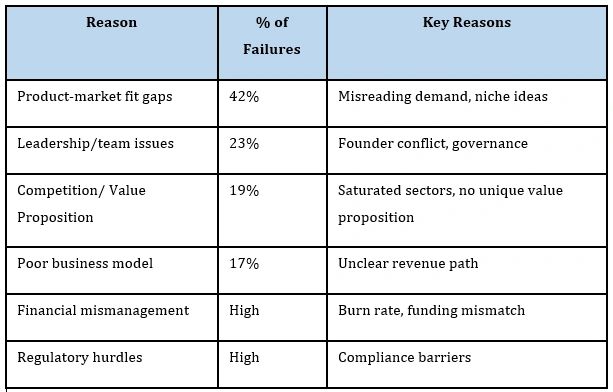
– Nearly 42% of the failed Indian startups cite misreading the market demand or lack of product-market fit as the primary reason for failure.
– Many startups launch without understanding the real market needs or target markets that are either ahead of their time or too niche for the scale required.
Poor Financial Planning and Cash Flow Management
– Improper financial planning causes overspending and inadequate cash flow, resulting in operational shortfalls.
– Failure to accurately estimate initial funding needs or revenue expectations is a recurring issue with budgeting.
– High burn rates without sustainable pricing economics led to the downfall of notable ventures.
– Under or over hiring without understanding the economics for scaling up in time.
– Funding mismatch, either through lack of access or premature raising of large capital, remains a key pattern in startup failures as financial prudence is a constant requirement.
Ineffective Leadership and Founding Team Issues
– Reports suggest that leadership conflicts, lack of experience, or weak governance are cited in almost 23% of failed startups.
– Public disagreements between founders and boards, misalignment of vision, and abrupt strategic pivots often demotivate teams and stall growth.
Competitive Saturation/ Value Proposition
– Around 19% of startups in India fail due to intense competition, especially in sectors deeply entrenched by large incumbents.
– Many founders underestimate competitive pressures and do not offer a unique value proposition strong enough to win market share.
– Customers buy a solution to solve their challenges. So, lack of unique value proposition in product strategy is a major failure point.
Regulatory and Compliance Challenges
– Complex and unclear regulations, bureaucratic hurdles, and compliance issues regularly stall or shutter startups if they fail to comply with the statutory requirements.
– Navigating India’s regulatory landscape is difficult, particularly for new fintech, health-tech, and e-commerce ventures lacking legal expertise.
Infrastructure and Talent Gaps
– Tier-2 and tier-3 cities lack the robust incubators, mentorship, and networks available in metros like Bengaluru and Delhi/ NCR
– Academic curricula frequently fail to produce industry-ready talent, creating skill shortages for crucial growth roles.
– The available talents often lack the crucial mix of technical and business growth mindset.
Inadequate Business Models
– Almost 17% of startup failures result from unclear or poorly defined business models that do not provide pathways to revenue or scale.
– Many business models are not sustainable due to faulty underlying assumptions about customer adoption, competition and pricing.
Table: Major Reasons and Statistics
Conclusion
India’s start-up ecosystem offers tremendous opportunities, but the underlying challenges of market fit, financial planning, competitive strategies, regulatory compliance, and leadership quality drive a consistently high failure rate. For entrepreneurs, addressing these systemic issues through strategic planning, robust business models, effective governance, and accurate market assessment is critical to reversing the years-long trend of start-up collapse.
At Strap Aerospace, we expertise in addressing these exact issues. In fact, except the regulatory piece, we have expertise in guiding, mentoring and handholding the fellow entrepreneurs to address each of these problems to help them succeed. From addressing the business strategy to talent gap, from competitive landscaping to business model refinement, Strap Aerospace (OPC) Pvt. Ltd could be the friend indeed whenever you need.
{Data references:
3. https://www.counselindia.com/blog-detail/the-percentage-of-startups-failing-in-india-
4. https://growthlist.co/startup-failure-statistics/
5. https://www.reddit.com/r/indianstartups/comments/1kf7d1s/90_startups_fail_indias_hidden_crisis_with/ }